How the
Xingu Seed Network works
The structure of the Xingu Seed Network is inspired
by the connections of a tropical forest, where all beings
are interconnected. Our intention is to function in the
most horizontal way possible — therefore, we consider all
our areas of activity equally important.
We know there is no ready-made formula to
promote inclusion and sustain a
collective as diverse as ours.
Even so, throughout 18 years of history and experience,
we have been building a methodology and governance
model adapted to the reality of our territory and our communities.
Organizational chart
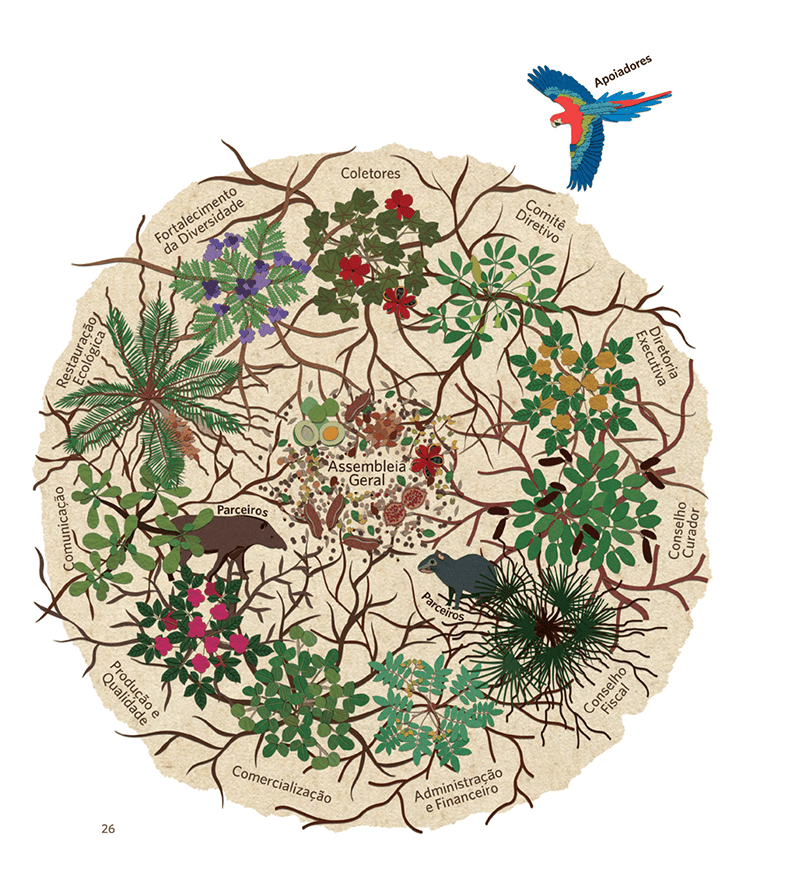
The Organizational Chart of the Xingu Seed Network shows how our
different areas of activity are organized and interconnected.
How we organize ourselves
in the Xingu Seed Network?

Seu Placides, accordion player from PA Manah and one of the
longest-standing collectors in the Network, takes part in the 2022 General Assembly.
PHOTO: Erick Veisch/Cama Leão/ISA
General Assembly
This is the main and highest decision-making body,
composed of all members of the Xingu Seeds Network.
It is held annually and all votes
carry the same weight in the matters voted on.
At the General Assembly, we elect (or remove, if the majority agrees)
the members of the Executive Board, the Fiscal Council, and the Curator Council.
In addition, the Assembly also reviews
and approves the annual accounts and the Network’s
work plans.

Vera and Madalena are collectors from the Nova Xavantina Group.
Together, they collect around 1,200 kg of seeds per year.
PHOTO: Bianca Moreno/ARSX and ISA
Collectors
Collectors are responsible for planning,
collecting, processing, pre-storing, and organizing
the distribution of the collected seeds. They also
closely monitor the nature of their territories,
observing the mother trees that produce the
healthiest seeds for collection.
In the Xingu Seeds Network, collectors are organized
into 24 Collector Groups distributed across
18 municipalities in Mato Grosso. Each Collector Group
is led by a person whose role is called
“Elo” or “Ela”.
Formed by Indigenous communities, family
farmers, and urban extractivists, the Network’s
Collector Groups are generally organized by territory,
social ties, and other affinities.
Currently, we have more than 700 seed
collectors, of whom around
80% are women.

Involved with the Xingu Seed Network since a young age,
Oreme Marlus Ikpeng is one of the current directors of the initiative.
PHOTO: Erick Vesch/Cama Leão/ISA
Steering Committee
Created in 2019, the Steering Committee is elected every
three years by the managers of the Collector Groups.
The team is composed of the Executive Board and
one additional representative from each of the
collector macro-groups of the Xingu Seeds Network –
that is, one representative from Indigenous communities,
one from family farming, and one from urban
extractivists, totaling six members.
In addition, the Committee is a communication
channel between the collectors, the technical team, and the
decision-making bodies. Its members decide on the
admission of new Collector Groups and on the approval
of scientific research involving the Network. They also
define guidelines for communication strategies.
Currently, the Steering Committee includes:
Bruna Ferreira, Eliane Righi, Eva Rodrigues, Milene
Alves, Oreme Marlus Ikpeng, and Tirawa Waura.
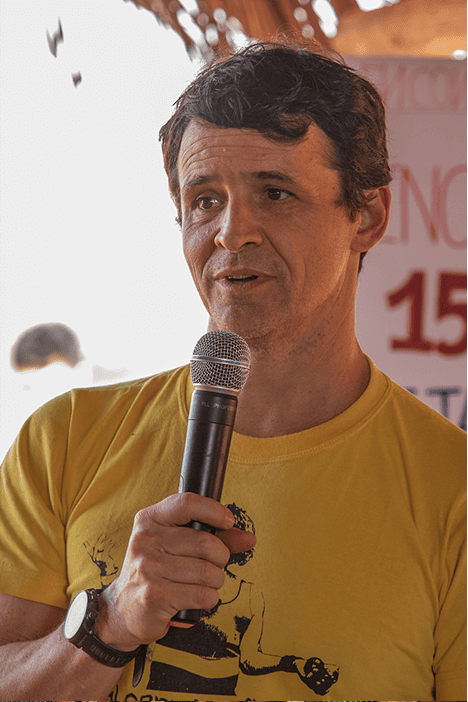
Francisco Gonsales, from the Fiscal Council, at the
15th Anniversary Gathering of the Xingu Seed Network.
PHOTO: Erick Veisch/Cama Leão/ISA
Fiscal Council
The Fiscal Council meets at least every six months and
is responsible for examining in detail whether the money of the
Xingu Seeds Network is being used as agreed
in the General Assembly.
In addition, it is also the responsibility of the Fiscal Council to verify whether
the expenses are fair and correct; whether the bills
are being paid and whether our accounting
is in order.
It is composed of three people elected by the General
Assembly, and the term of each member lasts three years.
Currently, our Fiscal Council is composed of:
Francisco Gonsales, Pedro Sonck Ferro and Wassayu Kitsapa.
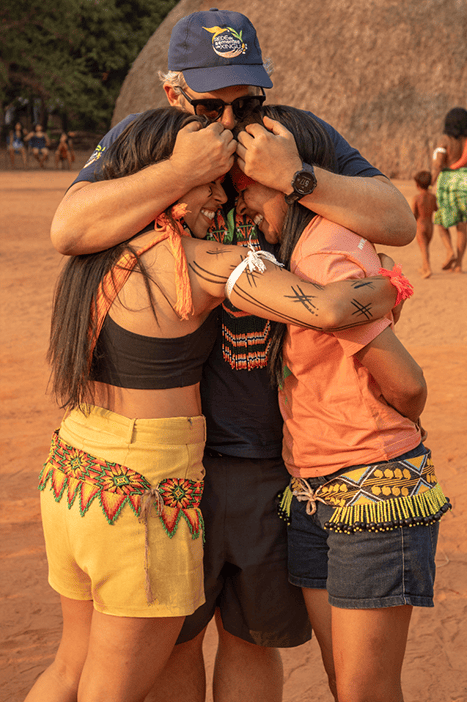
Rodrigo Junqueira, from the Advisory Council, has been present since the
beginning of the Network – as have Bruna Ferreira and Claudia Araújo,
embraced by him in this record of ARSX’s 15th anniversary.
PHOTO: Erick Veisch/Cama Leão/ISA
Advisory Council
The Advisory Council is composed of up to seven people
from diverse backgrounds (communities, universities,
companies, among others) who are engaged with
our Mission and our Vision with the aim of creating
guidelines for internal and external actions for the Network.
Therefore, it is the responsibility of the Advisory Council to: nominate
names for the election of members of the Executive Board;
advise on the creation of work plans and budgets
and articulate with other public and private institutions
to carry out collaborative activities aligned
with the interests of the Xingu Seeds Network.
Currently, the Advisory Council includes:
Andreas Ufer, Fátima Piña, Isabella Fagundes,
Rodrigo Junqueira, Rone Borges, Vania Aguiar
and Watatakalu Yawalapiti.

Bruna Ferreira, current president of the Xingu Seed Network,
embraces Claudia Araújo, who has also previously presided over the association.
PHOTO: Erik Veisch/Cama Leão/ISA
Executive Board
Just like the Steering Committee, the Executive Board of the
Network is also composed of people who represent
each of the three macro-groups of seed collection –
that is, one representative from Indigenous communities, one
from family farming, and one from urban communities –,
with one of them serving as the general director.
The Board is responsible for managing the actions and making
the Network’s day-to-day decisions, always based on the
agreements of the General Assembly. The term of each director
lasts three years.
Currently, the Executive Board of the Network
is composed of the following people: Bruna Ferreira (executive director),
Eliane Righi (representative of family farming)
and Oreme Marlus Ikpeng (Indigenous representative).

Lucio Ikpeng, Claudia Araújo, and Katu Kayabi are the front line
of our fieldwork, responsible for monitoring and supporting
the 24 Collector Groups of the RSX.
PHOTO: Lia Domingues/RSX
Strengthening
Diversity
The Diversity Strengthening team works
directly with collectors – especially
with Elas, Elos, and Group managers –,
supporting them to ensure the annual
seed collection targets are met.
This team also promotes training
and capacity-building meetings in
different formats to improve the
quality of production and the
relationships among the Collector
Groups, in addition to encouraging,
evaluating, and planning activities
together with them.
In this way, Diversity Strengthening
plays a fundamental role in weaving
together relationships, demands,
and the exchange of knowledge
within the Network, connecting the
technical team and the collectors.
Currently, this position is coordinated
by Claudia Araujo and has the support
of Ryweakatu Kayabi.
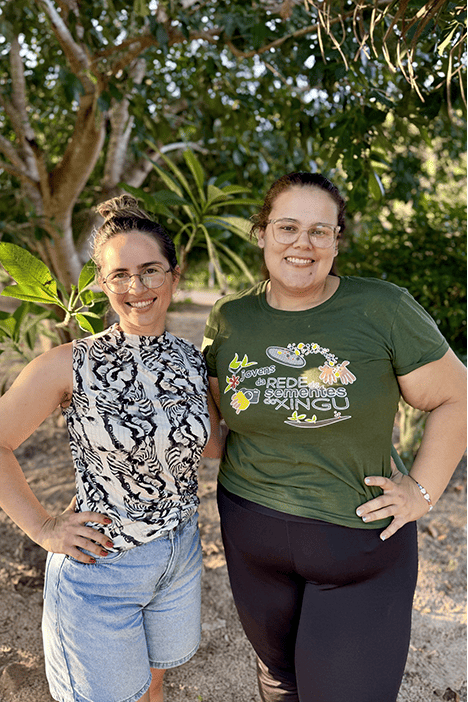
Kamila Parreira and Juliana Arcanjo are part of the Administrative
and Financial team of the Xingu Seed Network.
PHOTO: Lia R Domingues/ARSX
Finance
This team is responsible for making the
Xingu Seeds Network work in practice!
It handles purchases, hiring, and the
organization of the Network’s accounts
and taxes.
It also takes care of internal and external
financial transactions and any legal
activities when necessary.
Currently, the Administrative and Financial
area of the Network is managed by
Kamila Parreira and Juliana Arcanjo.
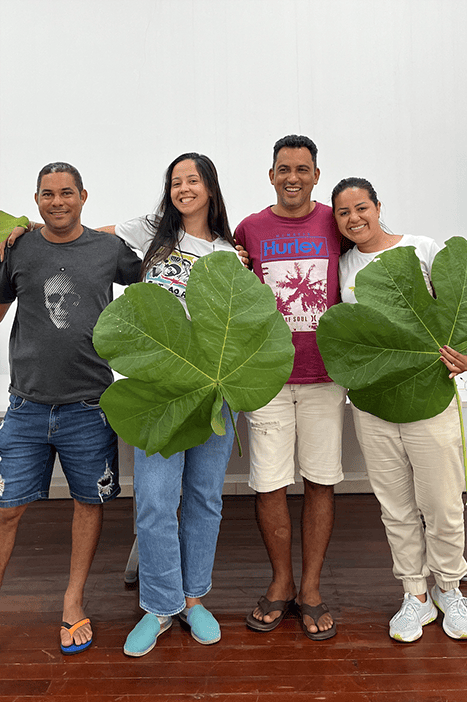
From left to right, Genésio, Evandro, Marcos, Emelysse,
Ângelo, and Natanael make up the most recent team responsible
for supporting and monitoring the Seed Houses.
PHOTO: Evandro Alves/RSX
Production and Quality
The Production and Quality team is responsible for the
receiving, storage, and quality control of the
collected seeds that arrive at the
Seed Houses.
Currently, the Xingu Seeds Network has
three Seed Houses, each located in the
municipalities of Porto Alegre do Norte/MT,
Canarana/MT, and Nova Xavantina/MT.
We also call the members of this team
“Guardians of the Seed Houses”, since they are
the ones who evaluate the quality of the seeds received,
control the inventory, support the
sales team, and send seed samples for
analysis in laboratories such as the
UNEMAT Seed Laboratory/Nova Xavantina Campus.
Currently, the guardians are: Evandro Alves, Genésio
Alves, Marcos Vinícius, and Natanael Lopes.

Marcos Vinícius, responsible for Commercialization, is also
a seed collector and biologist.
PHOTO: Bianca Moreno/ISA and ARSX
Commercialization
Commercialization is responsible for selling the
seeds collected by the Collector Groups of the
Xingu Seeds Network.
This area is responsible for seeking new clients and partners,
preparing commercial proposals, while also
maintaining a close relationship with the Seed Houses
to control the volumes of seed inflow and outflow.
In this way, this team ensures that the collected
seeds will be sold – that is, that collectors
will receive payment for their work – while also
making sure that all clients have their
orders fulfilled.
Currently, this role is led by Marcos Vinícius,
who is also a biologist and seed collector.
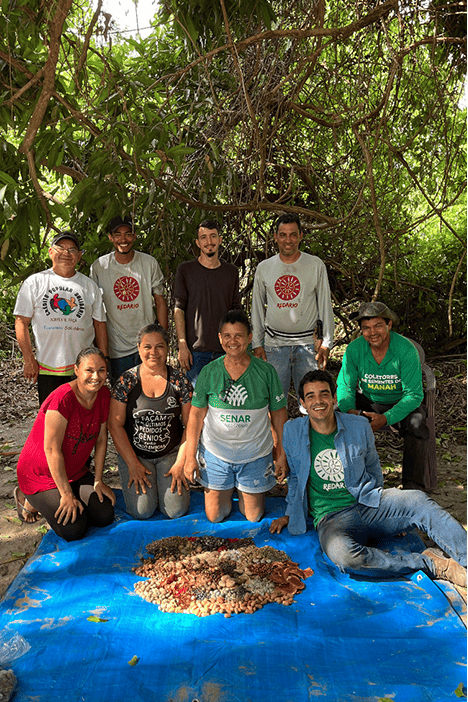
Renato and part of the Manah Seed Collector Group, during a planting
activity on the property of collector Nina.
PHOTO: Lia R Domingues/ARSX
Ecological Restoration
The Ecological Restoration team works
mainly on the execution of projects and on the
ecological restoration of the Xingu Seeds Network,
especially together with the Collector Groups,
whose collection areas have been undergoing
restoration since 2019.
In contact with the Commercial Sector, this team
can also monitor and support the ecological
restoration of certain areas with clients
and partners.
Currently, Ecological Restoration is
the responsibility of the forest engineers
Renato Nazário and Carlos Rodrigues.
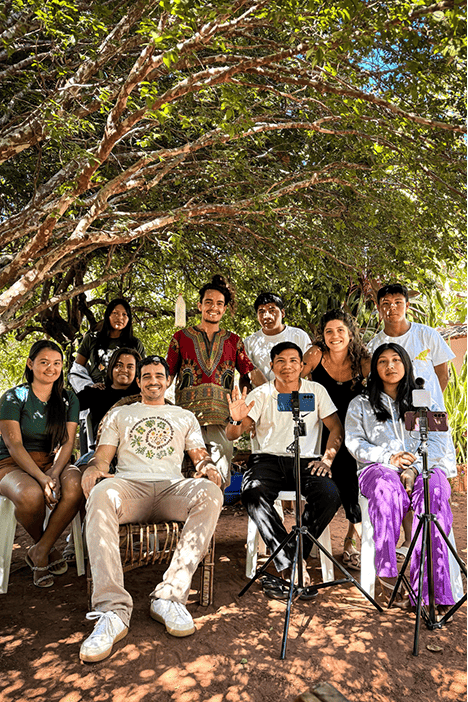
Lia Domingues and the Young Communicators of the Xingu Seeds Network:
Mirella Marino, Olinda Xavante, Edimara Cardoso, Itseitchumã
Waura, Marewi Juruna, Tariakatu Kayabi, and Kudayawa Juruna, at the II Training
of the project that initiated the Communication work with youth.
The photo also features the workshop facilitator Arthur Marques and the technician Renato Nazário.
PHOTO: Are Yudja/RSX
Communication
Communication works on the continuous construction of
coherent and non-violent dialogues that represent the
shared ideas and positions of the members of the
Xingu Seeds Network.
The objective is to encourage understanding and the flow of ideas
and actions among everyone involved in the
communication processes</span inside and outside the Network.
Among the activities carried out by Communication
are the updating of the website and social media,
responding to journalists and filmmakers, and publishing
materials for internal and external communication about the Network.
Currently, this position is held by the socio-environmental
communicator Lia Rezende Domingues.
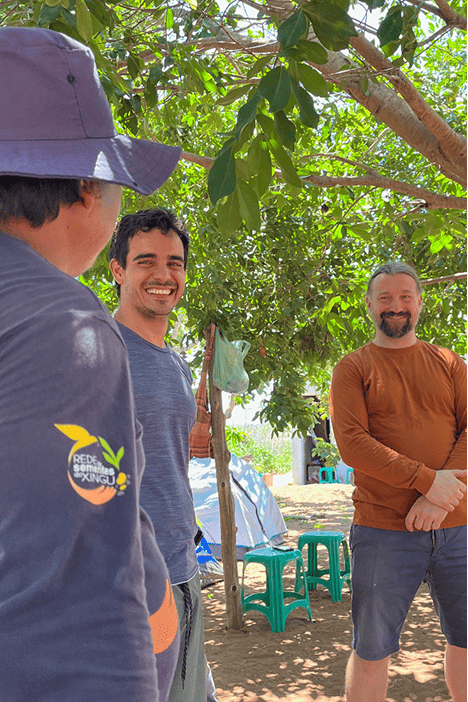
From left to right: Cirino Hi’a’u, Xavante leader; Renato Nazário,
from the Ecological Restoration team of the Network; and Geir Finstad, from Rainforest Norway.
PHOTO: Lia R Domingues/ARSX
Partners and Supporters
Partners and supporters are different organizations,
such as individuals, private companies,
governmental and non-governmental institutions,
that support the Xingu Seeds Network through
funding and other strategic actions.
Some of the supporters are institutions that provide
funding for the Network’s activities
through projects managed and monitored by
them. These projects are temporary and go through
stages of proposal, evaluation, adjustments, approval,
audit, and completion.
Financial cycle
of the Xingu Seed Network come from?
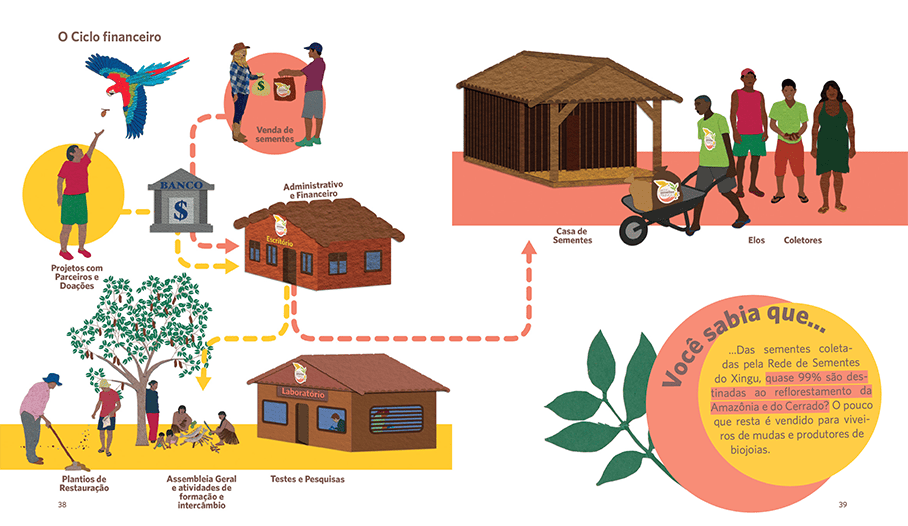
At the Xingu Seed Network, the money
is used strategically to:
strengthen
communities
and their traditions
>
protect their
territories
>
promote the value chain
of native
seeds
>
contribute to
ecological restoration
at different scales.
Based on our Mission, our resources are used in all stages of
seed production, such as payments to collectors, purchase of tools,
construction and maintenance of the Seed Houses, and logistics.
Our funds are also applied in the organization of events, training sessions and exchanges,
as well as in office maintenance and the payment of employees and collaborators.
As we are a non-profit association, we depend on obtaining
resources to ensure our operation and continuity.
Currently, we have three main sources of income. Learn about them below.
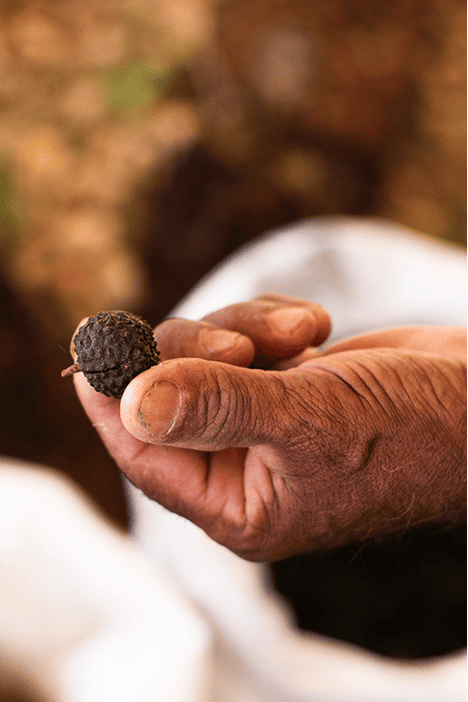
Mutamba seed in the hands of Mr. Hermínio,
collector from the Nova Xavantina Group.
PHOTO: Bianca Moreno/ARSX and ISA
1. Seed
commercialization
Seed sales are the Network’s primary source of
financial resources. Our prices are generally
based on the native seed and ecological
restoration market.
When the seeds are sold, the money received
is used to pay collectors for the work of
collecting and processing the seeds.
Seed sales also help cover storage costs,
such as the maintenance of the Seed Houses
and payments to the guardians of the Houses.
This income also pays for office activities,
taxes, the purchase of materials and tools,
as well as logistics and transportation expenses.
Seed prices are always discussed with
collectors and validated in the Assemblies.
Ideally, all commercialization activities
should be paid for through seed sales.
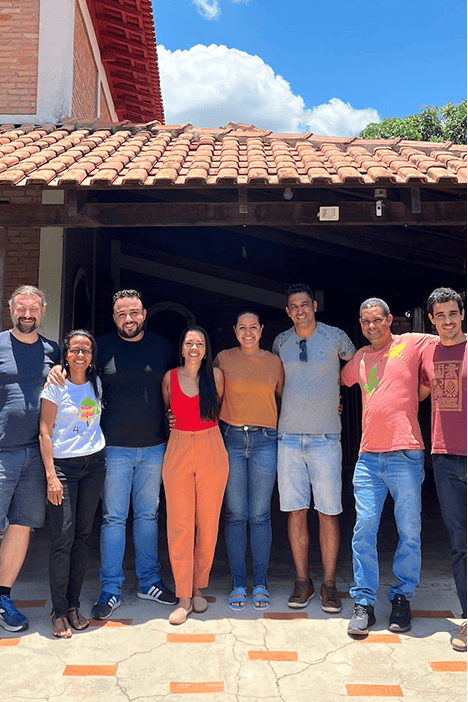
Part of the team gathered with Geir Finstad, from Rainforest Norway (RFN),
one of the supporters of the Xingu Seed Network since 2021.
PHOTO: Lia R Domingues/ARSX
2. Projects in partnership
with other institutions
Since 2018, the Xingu Seeds Network has
participated in calls for proposals for projects
funded by national and international
institutions.
The projects for which we prepare proposals must
address the Network’s operational needs and
aspirations, based on real conditions. The communities,
associations, and other organizations involved in the
activities to be funded by the project must also take
part in this process, evaluating and proposing
adjustments.
The first step is to assess the current and urgent
objectives of the Xingu Seeds Network. Next,
a thorough reading of the call for proposals is carried out,
followed by the preparation of the texts and
the necessary documents for the proposal.
To date, we have been supported by projects with
initiatives and programs such as PPP-Ecos, REM/MT,
Rainforest Norway (RFN), Floresta Viva, ICRAF/CIFOR,
and Fundo Amazônia (FAM).
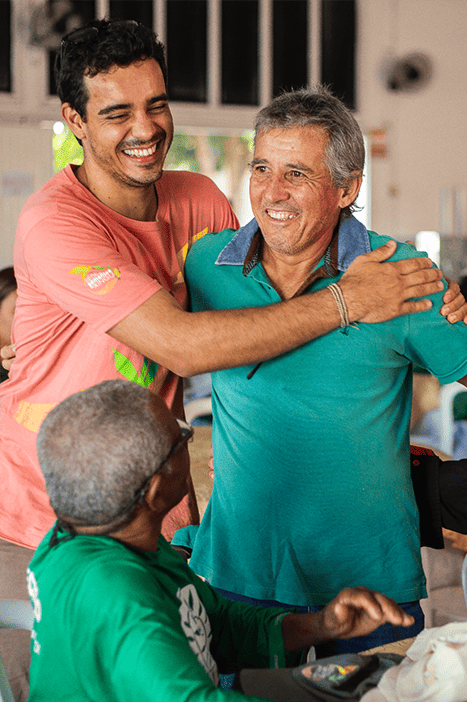
Renato, a technician of the Network, embraces Mariozan,
a seed collector from family farming in Nova Xavantina/MA since 2012.
With his back to the camera, Seu Hermínio, a collector since 2007.
PHOTO: Bianca Moreno/ISA e ARSX
3. Donations
As an initiative that generates income, health, and joy
in the territories of the collectors, the Xingu Seeds
Network receives support from several institutions
and individuals who admire and value our work.
This support is primarily directed toward the activities
of the 25 Collector Groups, such as meetings,
exchanges, workshops, and transportation.
These activities are essential for strengthening the
diversity of cultures and knowledge — aspects that
the Network values and aims to promote.
The movement of donation funds — which are also
used to support these activities — is monitored by
the Administrative team and supervised by the
Fiscal Council. Every year, the total amount of
donations received in the previous period is also
presented and discussed during the Assemblies.
The Financial Cycle of the Xingu Seed Network,
as illustrated in the Collector’s Handbook:
Transparency
Below, you can view and download some documents for free
that record the good Governance practices of the Xingu Seed Network.
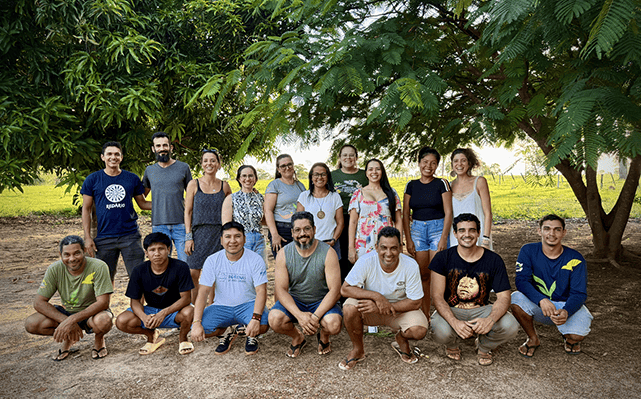
RSX technical team at the 2026 Strategic
Planning Meeting in Nova Xavantina.
PHOTO: Archive/RSX
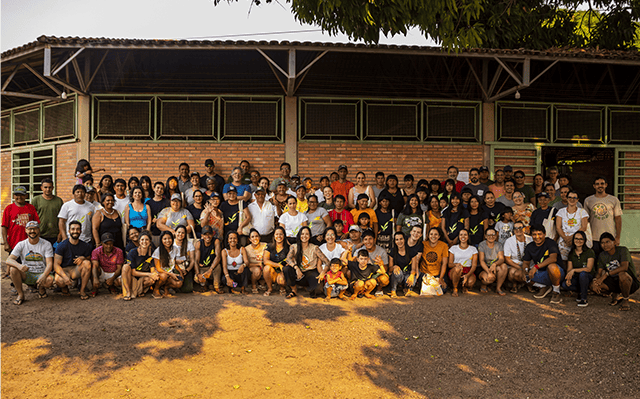
Collectors, technicians, and partners at the XVIII Gathering of Collectors
of the Xingu Seeds Network, held in São Félix do
Araguaia in September 2024.
PHOTO: Bianca Moreno/ISA e ARSX